Get Weather from Command Line
There's an awesome script making the rounds on Twitter and I've been as excited as everyone else so I thought I'd show it. Many of us live eight hours a day within the command line (although I'm not a vim hippie like some of you) so I try to find new ways to accomplish tasks from within iTerm (like getting bitcoin value or stock quotes). Many of these solutions include using cURL and this awesomeness is no exception!
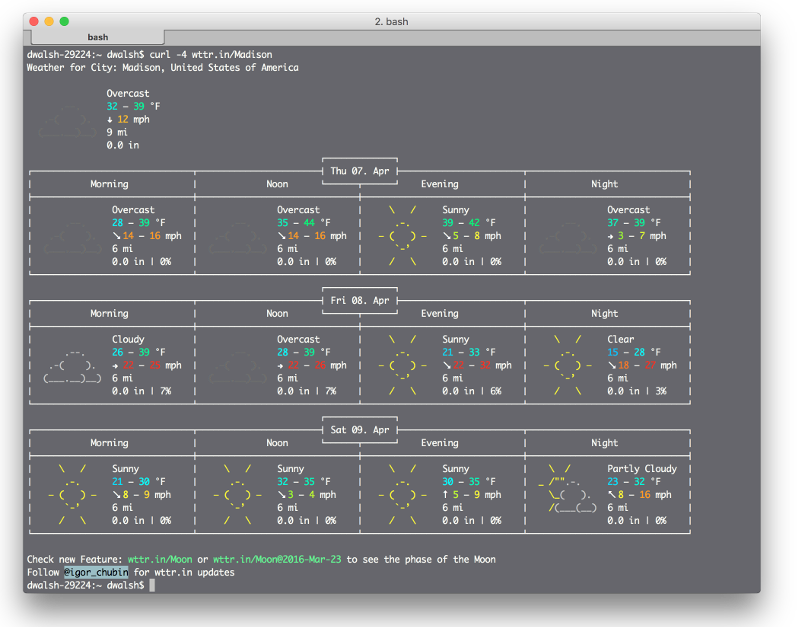
You can get weather information from command line using cURL and wttr.in:
# Allow geolocation
curl -4 wttr.in

# Request a city
curl -4 wttr.in/Madison
wttr.in does well to guess location if one isn't provided so in most cases you wont need to provide your city.
There you go, another awesome way to get the information you need from command line!
![Interview with a Pornhub Web Developer]()
Regardless of your stance on pornography, it would be impossible to deny the massive impact the adult website industry has had on pushing the web forward. From pushing the browser's video limits to pushing ads through WebSocket so ad blockers don't detect them, you have...
![Create a CSS Flipping Animation]()
CSS animations are a lot of fun; the beauty of them is that through many simple properties, you can create anything from an elegant fade in to a WTF-Pixar-would-be-proud effect. One CSS effect somewhere in between is the CSS flip effect, whereby there's...
![Multiple Backgrounds with CSS]()
Anyone that's been in the web development industry for 5+ years knows that there are certain features that we should have had several years ago. One of those features is the HTML5 placeholder; we used JavaScript shims for a decade before placeholder came...
![9 Mind-Blowing WebGL Demos]()
As much as developers now loathe Flash, we're still playing a bit of catch up to natively duplicate the animation capabilities that Adobe's old technology provided us. Of course we have canvas, an awesome technology, one which I highlighted 9 mind-blowing demos. Another technology available...







Frickin’ genius!
This is excellent! As a relative rube when it comes to the command line though, can someone kindly explain the purpose of
-4in the command? I seem to get the same results whether I include it or leave it out.its used for Resolved name to IPv4 Address
It looks like iTerm here translates/renders the curl response HTML output? Or curl implicitly does that (if so what version of curl are you using)? Because the raw HTML (unprocessed) does not look as nicely displayed as the screenshot. Only if you render the HTML will it look like that.
I created an (OS X only) to automatically show your local weather:
https://gist.github.com/6343547a0169e9b6167d