Show FPS for Steam Games
There's nothing more frustrating to a top gamer (outside of bugs in a game) than dropped frames in a video game. If you're playing a competitive multiplayer game like PUBG or Fortnite, where up to 100 people are simultaneously competing, dropped frames can be the difference between ecstasy or a bullet between the eyes.
While poor frame rate is usually a reflection of underperforming hardware/software, bad code, or server lag, the first step in identifying poor frame rate is directing Steam to display the frame rate during the game. Let me show you how to direct Steam to output the frame rate of a game!
Start by going to Settings > In-Game:
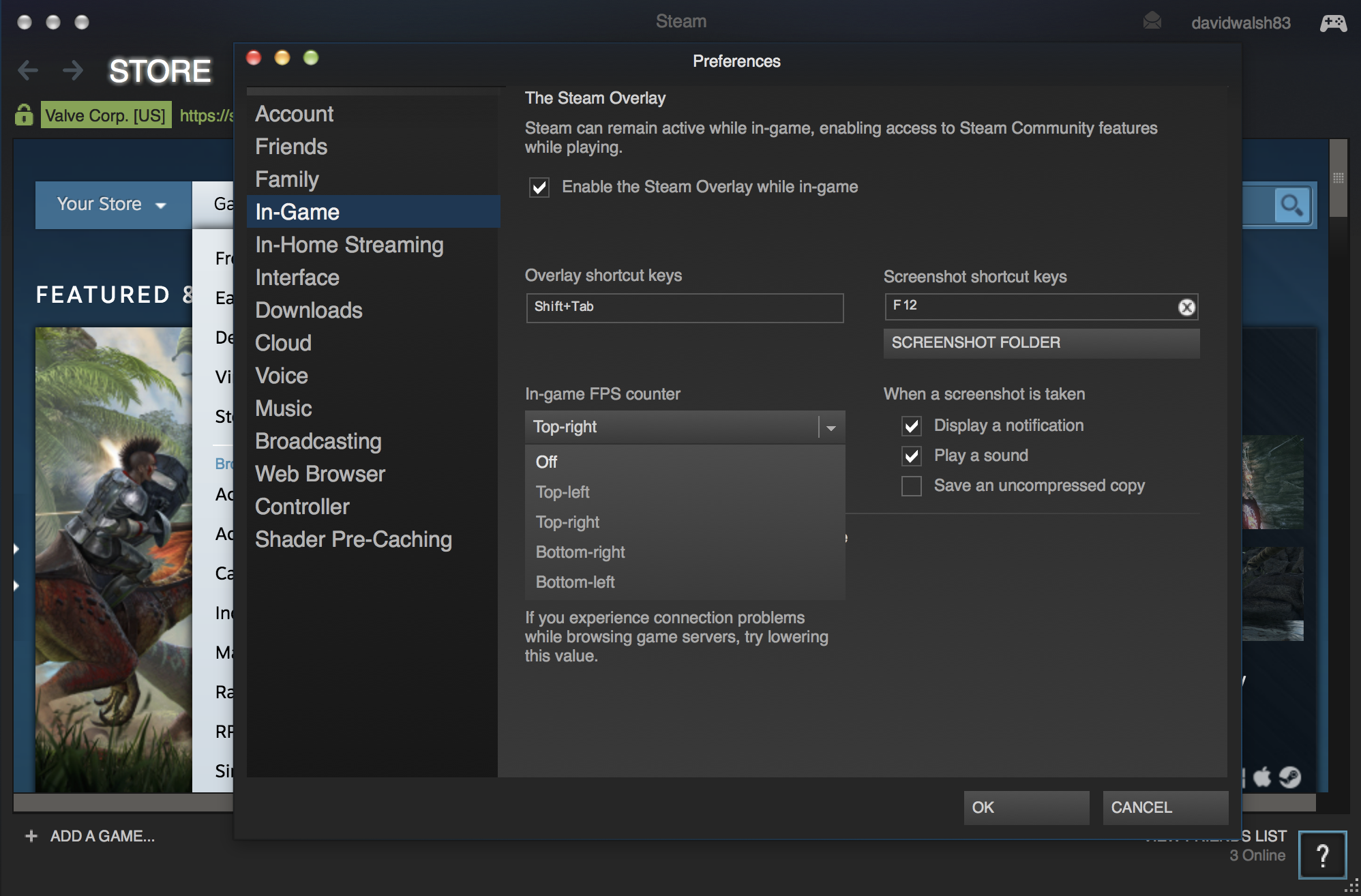
A dropdown under the In-game FPS Counter allows you to position the FPS counter anywhere on the screen; you can even allow high contrast color display of the FPS. When you open the game, you'll see the FPS displayed in the position you selected.
While there's not much you can do to improve FPS outside of improving your CPU and GPU, it's good to see the FPS at a given time and determine if more can be done to make a game perform!

![CSS Filters]()
CSS filter support recently landed within WebKit nightlies. CSS filters provide a method for modifying the rendering of a basic DOM element, image, or video. CSS filters allow for blurring, warping, and modifying the color intensity of elements. Let's have...
![Regular Expressions for the Rest of Us]()
Sooner or later you'll run across a regular expression. With their cryptic syntax, confusing documentation and massive learning curve, most developers settle for copying and pasting them from StackOverflow and hoping they work. But what if you could decode regular expressions and harness their power? In...
![Making the Firefox Logo from HTML]()
When each new t-shirt means staving off laundry for yet another day, swag quickly becomes the most coveted perk at any tech company. Mozilla WebDev had pretty much everything going for it: brilliant people, interesting problems, awesome office. Everything except a t-shirt.
That had to change.
The basic...
![Using MooTools For Opacity]()
Although it's possible to achieve opacity using CSS, the hacks involved aren't pretty. If you're using the MooTools JavaScript library, opacity is as easy as using an element's "set" method. The following MooTools snippet takes every image with the "opacity" class and sets...